

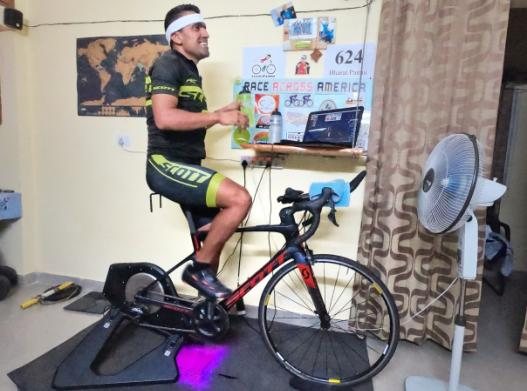
Race-day fuelling gets all the attention. But a race is only a few days; the rest of the year is where the engine is actually built. What I eat when no one is watching — the ordinary plate on an ordinary training day — matters far more to my results than anything I swallow during an event.
The mistake I see most often in endurance athletes is under-eating in training. People associate getting lean with eating less, and then wonder why their big sessions fall apart and their recovery drags. If you are riding serious volume, food is not the enemy of performance — it is the raw material of it. You earn the right to ride hard by eating enough to support it.
Build the plate around the work
My everyday eating is built around carbohydrate, protein and vegetables, in roughly that order of volume, with enough fat to keep everything running. Carbohydrate fuels the training; on heavy days I eat more of it, on rest days less. I don't see rice, roti, fruit or potatoes as something to fear. They are what let me turn up to the next session with something in the tank.
As a non-vegetarian I lean on eggs, chicken and fish for the bulk of my protein, alongside dal and whatever the kitchen is serving. An endurance athlete needs more protein than people expect — not to build bulk, but to repair the damage that daily training does and to hold on to muscle while carrying a light race weight. I aim to get a good dose of it at most meals rather than loading it all into one.
The unglamorous truth is that most of this is just balanced Indian home food. I don't eat anything exotic. A proper thali — grain, protein, vegetables, some curd — is close to an ideal athlete's plate, and it has the advantage of being food I actually enjoy and can sustain for years, which is more than can be said for most "performance" diets.
The hour after matters
After a hard or long session I make a point of eating reasonably soon — a mix of carbohydrate to refill the tank and protein to start the repair. You don't need a laboratory for this; a real meal does the job. The riders who recover well are usually just the ones who don't skip that post-session plate because they're tired or busy. Consistency beats precision here.
Hydration is part of nutrition too, and so, frankly, is sleep. I can eat perfectly and still train badly if I haven't slept. I treat rest as a training input, not a reward — the body does its rebuilding while you're unconscious, and no plate can replace that.
On supplements and race weight
I keep supplements simple and evidence-led. The plate comes first; a supplement is there to fill a genuine gap, not to do the job that food and sleep should be doing. I'm wary of the rider whose kitchen counter looks like a pharmacy — it usually signals a diet that isn't working underneath.
On weight: yes, climbing rewards being lean, and I do ride lighter for big events. But I do it gradually and around my training, never by starving the work itself. Crash-dieting into a race is one of the surest ways to arrive fast and finish slow. Health first, always — a body that is fuelled and rested will out-ride a lighter one that is running on empty.
A note on discipline
People imagine elite nutrition is grim and joyless. Mine isn't. The discipline is in the defaults — eating well most of the time, by habit, so that it costs no willpower — which then leaves room for the occasional meal eaten purely because I want it. Ninety-five percent right, applied every single day, beats perfection you can only hold for a month.
If I had to compress it all into a few lines:
- Eat enough to support your training — under-fuelling is the silent killer of progress.
- Build plates around carbohydrate, protein and vegetables; for me, eggs, chicken and fish carry the protein.
- Eat a proper meal in the hours after hard work.
- Treat sleep and hydration as part of your nutrition.
- Keep supplements minimal and let food do the heavy lifting.
- Get lean slowly, around your training, never at the expense of it.