An Indian Army officer with no sporting background who took up cycling at 33 and rewrote the record books — proof that it is never too late to start.
There is a simple fact at the heart of Bharat Pannu’s story that stops people: he picked up competitive cycling at thirty-three, with no sporting background whatsoever, and within a few seasons held three Guinness World Records, set four WUCA world records, and became the first Indian to stand on an international ultra-cycling podium.
He is a serving Indian Army officer, an aeronautical engineer by training, a TEDx speaker, and one of the most decorated ultra-endurance cyclists India has ever produced. But none of those labels fully captures what he is — a man who bet everything on a late, unlikely beginning, and won.
The road he has ridden is not a straight line. It runs through the Himalayas and the American desert, through a broken collar bone and two agonising DNFs at the world’s toughest race, through years of pre-dawn sessions and the quiet graft that no photograph records. This is that story.
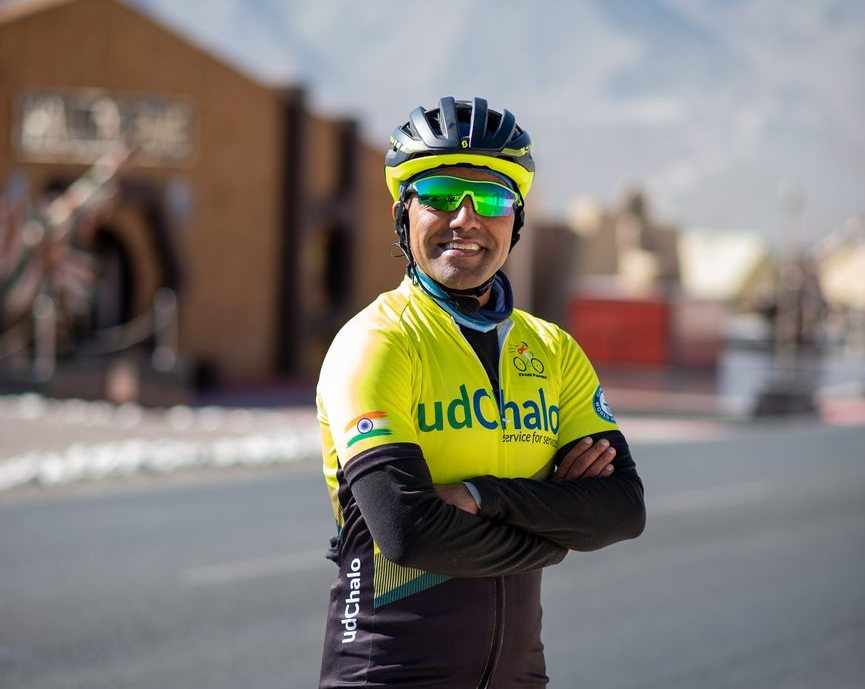
Bharat Pannu was born on 08 May 1982 in Rohtak, Haryana, into a household shaped by the Indian Army. His father wore the uniform, and growing up in that world meant absorbing its values before he could articulate them — discipline, service, sacrifice, the quiet dignity of a life devoted to something larger than oneself. From his earliest years, he knew what he wanted to be.
As a child, he rode a bicycle. Not for sport — simply to get to school and back. There was no training plan, no club, no coach waiting at a weekend ride. Just the ordinary rhythm of two wheels on a Haryana road, a habit he would not revisit in any meaningful way for three more decades. In school and in college there was no athletic identity, no event that claimed him. He was the student who studied hard, who had a head for engineering, who set his sights on the Indian Military Academy at Dehradun.
He got in. And in 2006, freshly commissioned as a Lieutenant, he stepped into the Corps of EME — Electrical and Mechanical Engineers — an aeronautical engineering specialist in a uniform that meant everything to him. The dream his father had planted was now his reality. For the next decade, the Army consumed him entirely: postings, exercises, technical work, the relentless tempo of military life. If there was a sport, it was running — he ran with the discipline the institution expected, and he was good at it. Cycling, in the competitive sense, did not exist in his world.
“Beyond every bend in the road lies a new possibility waiting to be discovered.”— Bharat Pannu
In September 2016, a posting brought him to Nashik. The city had a quiet but growing cycling culture, and somewhere in those early weeks he picked up a road bike. He was thirty-three years old.
What began as a way to stay fit quickly became something he could not explain. There was something about the open road — the way distance collapsed and expanded simultaneously, the fact that on a bicycle you were alone with your effort and nothing else. Silence, except for breathing and the hum of tyres. For a man trained to push through discomfort, ultra-distance cycling turned out to be an almost perfect fit. He did not know that yet. He was simply riding.
By January 2017 — two months after first throwing a leg over a road bike — he entered his first competitive event: the Ultra Spice Race, a gruelling 1,000 km across Indian terrain. He won it. He also earned the Super Randonneur title that same season, a credential that marks a rider capable of sustained extreme effort over multiple back-to-back distances.
Tired and sunburnt at that first finish line, he had no real idea what had just begun.
“I had no background in sport whatsoever — not school, not college. The only cycling I knew was riding to school and back. When I started in Nashik I was simply looking for something to do. I had no idea it would take over my life.”
The progression was rapid, and his ambition matched it. In August 2017, Bharat and his partner entered the Race Around Austria — a multi-day ultra-cycling event through the Alps and across Austrian terrain, one of Europe’s most demanding road races. They finished, placing 5th in the two-person category. They were among the first Indians ever to complete an ultra-distance race on European soil — in a field of seasoned international competitors who had been racing for years.
He returned to India with something new: a concrete sense of what was possible. The world of ultra-cycling was enormous, and he had begun to understand where, with work, he might sit within it.
2018 and 2019 were years of steady, deliberate expansion. He crewed for the first visually-impaired team to finish the Race Across America — a 4,800-kilometre transcontinental race from California to Maryland widely considered the world’s toughest bicycle race — which gave him a ground-level education in what a RAAM campaign truly demands: the logistics, the sleep deprivation, the crew choreography, the mental architecture required to keep moving when the body has long since asked to stop. That experience was not incidental. It was preparation.
In late 2019 he set the Kashmir-to-Kanyakumari WUCA world record — cycling the full length of India solo, covering 3,604 km — an announcement, quiet but unmistakable, that something serious was developing.
Then came the moment that could have ended everything before it truly began. May 2019, Salton Sea, California. Training for his first solo RAAM attempt. A crash. A broken collar bone. Twenty days before the race.
Most would have withdrawn. The injury was real, the recovery incomplete, the risk of further damage considerable. Bharat went to the start line anyway. That RAAM did not finish the way he wanted — it ended in a DNF — but the fact of standing at the start line, broken and prepared to go, said something about the man that no podium finish could.
“The greatest obstacles are often the ones we create in our own minds. Dare to think bigger than your limitations, pursue your goals relentlessly and never surrender to adversity. Every individual possesses unique potential — the challenge is to unwrap that gift and put it to work.”— Bharat Pannu
2020 became the most remarkable year of his cycling life, and it arrived wrapped in the strangest circumstances.
The world had shut down. COVID-19 had closed borders, cancelled every race on earth, and driven the cycling community indoors. The Virtual Race Across America emerged as an unlikely alternative — riders covering the RAAM distance on stationary trainers, their GPS data logged in real time. It felt, to many, like a pale substitute for the real thing. Bharat went into it differently.
He finished 3rd overall at V-RAAM 2020. First in his age category. First Indian ever to take an international podium in ultra-cycling. It happened on a trainer in a closed room, and it mattered exactly as much as if it had happened on an open highway. Within weeks, he was felicitated by Defence Secretary Dr Ajay Kumar at the Ministry of Defence in recognition of what the achievement represented for Indian sport.
Then, in October 2020, he turned to the mountains. The Leh–Manali highway: 472 kilometres of Himalayan road threading through some of the world’s highest motorable passes, at extreme altitude, in conditions that demand complete physical and psychological submission. He set the Guinness World Record. The photograph from those days shows a man completely chiselled — carved down to nothing but will and sinew.
Also in 2020: the Golden Quadrilateral Guinness World Record. Nearly 5,942 kilometres connecting Delhi, Mumbai, Chennai and Kolkata — the great highway spine of India — ridden end to end in record time. Two Guinness records in a single year, plus an international podium. By any measure, 2020 was the year Bharat Pannu announced himself to the world.
“The race belongs to the rider who shifts to the right gear at the right moment.”— Bharat Pannu
The records kept coming. In 2021 he set a third Guinness World Record: the fastest cycle traverse of India from west to east, from Gujarat to Arunachal Pradesh — the two coasts of the subcontinent, connected by one man on two wheels. The sheer scale of these rides is difficult to absorb: India from top to bottom, India across its widest point, India corner to corner. He had, in the space of a few years, mapped the country with his wheels.
That same year he was appointed Officer In-Charge of the Army Cycling and Rugby Teams, a role he held until 2023. In that capacity he turned outward — not just riding himself but working to develop the ecosystem around elite Army sport, supporting athletes, building structures, trying to invest in the generation that would come after him.
The Race Across America remained unfinished business. The 2019 attempt had ended with a broken body. In June 2022, he was back at the start line in Oceanside, California, for his second solo attempt. By Day 9 he was deep in the race, moving well — and then a high fever stopped him. Another DNF. Another year of carrying that particular weight.
“Everyone deals with adversity. It’s how you bounce back from it.”— Daniel Cormier
He came home and he did not give up. He went back to Coach Tracy McKay in Alabama. He rebuilt. He trained harder and with more precision. He understood, by now, what RAAM demanded that he had not fully given it before. The preparation for 2024 was different in kind, not just degree.
In June 2024, Bharat Pannu finished the Race Across America. All 4,800-plus kilometres of it — from Oceanside to Atlantic City, New Jersey, through the desert, through the mountains, through the heartland, across the Eastern Seaboard. He won the Armed Forces Cup. The photograph from the finish arch in Atlantic City shows Team Pannu together under the banner of the world’s toughest bicycle race, and Bharat at the centre of it — the look on his face is not triumph, exactly. It is something quieter and deeper than that.
He had broken a collar bone for RAAM. He had ridden two failed attempts at RAAM. And now he had finished RAAM. The circle was complete, and it had taken eight years of relentless work to close it.
“Our greatest weakness lies in giving up. The most certain way to succeed is always to try just one more time.”— Thomas A. Edison
Those who have followed Bharat’s career closely will tell you that the physical achievements, extraordinary as they are, are not quite the full story. What separates him from other talented riders is the quality of his mind — specifically, the way it works under conditions that would break most people’s thinking entirely.
He approaches ultra-cycling the way an aeronautical engineer approaches a complex system: with rigour, with systematic planning, with a clear understanding of what can be controlled and what must simply be endured. He breaks impossible distances into the manageable — five thousand kilometres into the next twenty-five, as he described when he spoke at TEDx KIIT University in a talk titled “Cycling My Way to Euphoria: Beyond Exhaustion, Into Clarity.” How the mind travels past the body’s limits. Why euphoria is not waiting at the finish line, but lives within the struggle itself. The hall listened. The talk has stayed with people.
In 2025, he completed the High Performance Leadership Program run by the Abhinav Bindra Foundation in collaboration with Loughborough Sport, UK. He was awarded the Certificate of Excellence for submitting the best project in the entire cohort — a group of accomplished, high-performing individuals from across Indian sport. It was, in its way, entirely characteristic: even in a structured program attended by remarkable people, he did not settle for participation.
The records are one kind of legacy. Bharat has been quietly building another kind alongside them.
Ahead of the Race Across America 2019, he launched his Go Green initiative — pledging a tree for every kilometre of the RAAM route. 5,000 saplings were planted near Nashik, with three years of funded upkeep to ensure they grew into something lasting and self-sustaining. A world-record attempt turned into an act of environmental restoration. The land that cycling had given him purpose on, given something back to.
During V-RAAM 2020, at the height of the pandemic, he also rode to raise support for small entrepreneurs whose livelihoods had been devastated. Every big ride, he has said, should carry a bigger purpose. He has meant it.
He is now settled in Satara, Maharashtra — a city tucked into the Western Ghats, with its own cycling culture and its own clean air. He still rides. He still competes. He is still coached by Tracy McKay across twelve thousand kilometres of distance, a relationship built on mutual trust and years of results.
But his thinking has begun to extend beyond his own career. He has spoken openly about wanting to build a cycling academy — a proper structure to identify and prepare the next generation of Indian ultra-cyclists who can compete and win internationally, not just participate. The boy from Rohtak who had no sporting background and no one to show him the way wants to build that path for those who come after him. That, too, is a kind of record.
“It is never too late to start.”— Bharat Pannu
Three Guinness World Records. Four WUCA world records. A Race Across America finish. India’s first international ultra-cycling podium. A TEDx stage. A military career of nearly two decades. The numbers are real, and they matter. But the number that matters most — the one he returns to most often, the one that defines everything — is 33. The age at which he began. The proof, lived in public, that the start line is open at any age, to anyone willing to show up for it.
The road continues. He is still on it.
Takes up cycling in November 2016 and starts racing two months later, winning the inaugural Ultra Spice Race and earning the Super Randonneur title in his first season.
Completes the Race Around Austria — among the first Indians to finish an ultra-distance race on European soil.
Crews for the first visually-impaired team to finish RAAM, then sets the Kashmir-to-Kanyakumari WUCA world record across India.
Guinness World Records on the Golden Quadrilateral and Leh–Manali, plus a 3rd-overall V-RAAM finish — the first international ultra-cycling podium by an Indian.
Sets the Guinness World Record for the fastest west-to-east traverse of India, Gujarat to Arunachal Pradesh.
After two solo DNFs, finishes the Race Across America solo and wins the Armed Forces Cup.
Completes the one-year High Performance Leadership Program run by the Abhinav Bindra Foundation in collaboration with Loughborough Sport, UK, and is awarded the Certificate of Excellence for submitting the best project in the cohort.
“Life is not a journey to the grave with the intention of arriving safely in a pretty and well-preserved body. But rather, to skid in broadside, thoroughly used up, totally worn out, and loudly proclaiming … WOW … What a ride!!!”— Mark Frost
As a child he was drawn to two things — the Army and the bicycle. One came from his father and gave him purpose; the other became his escape, and gave him freedom. There was no sporting background — not in school, not in college; the only cycling he knew was riding to school and back. These frames trace the whole arc: the family album, the uniform, the quiet transition years, the unphotographed graft — and the road ahead, where he plans a cycling academy to prepare India's next generation of international medal winners.
Beyond the records, Bharat is a TEDx speaker who shares the mindset behind ultra-endurance — discipline, resilience and the belief that it is never too late to start. Available for keynotes, corporate sessions and motivational talks.
Bio & Highlights
Download Media Kit ↓