

I have said before that somewhere around 1,750 kilometres, a race stops being about fitness. By then you have used almost everything your training prepared you for. What carries you the rest of the way is your mind — its tolerance for pain, its willingness to keep deciding, hour after hour, that you are not done yet. The body sets the ceiling. The mind decides how close to it you can live.
This is the part of ultra-cycling no one trains you for, because you can only really learn it by going there.
Sleep is a weapon you barely get to use
On the Golden Quadrilateral I slept three, maybe four hours a night for almost fifteen days. On the virtual edition of RAAM I was on the bike for something like twenty-one or twenty-two hours a day. Sleep, at that point, is not rest — it is a rationed resource, and every minute you spend asleep is a minute you are not moving. The discipline is in choosing the pillow over the pedals at exactly the right moment, taking just enough to keep the engine and the brain functioning, and then getting up while every cell in you is begging for more.
I have learned to use the micro-nap — ten or fifteen minutes, sometimes by the roadside — as a reset button. Done at the right time, it can return more than an hour of clear riding. Done at the wrong time, it just steals momentum. Knowing the difference is its own skill.
The long dark
Deep into a sleepless ride, the night plays tricks. The mind, starved of rest, starts to fill in things that aren't there — shapes at the edge of the headlight, sounds, a sense that the road is doing something it isn't. Every experienced ultra-rider knows this country. The trick is to expect it, to recognise it for what it is, and to lean on your crew, whose clear heads are there precisely to catch what your tired one cannot. When the rider's judgement frays, the crew's becomes the judgement that matters.
Pain, and what it actually is
Most of the pain in a long race is not damage — it is just discomfort, loudly demanding that you stop. Learning to tell the two apart is, I think, the single most important mental skill in this sport. Damage you respect; you stop, and I'll come back to that. But ordinary suffering you can negotiate with.
The way I negotiate is by shrinking the race. The finish line, three thousand kilometres away, is a number too large for the mind to hold without panic. So I don't ride to the finish. I ride to the next time station, the next town, the next ridge — sometimes the next telephone pole. Get there, then choose the next small thing. A race that is unbearable in one piece becomes almost manageable in a hundred small ones.
And underneath all of it, you need a reason. On the hardest nights, what kept me turning the pedals was rarely the record itself. It was the people who had bet on me — the crew, my coach, the Army, my family — and the simple refusal to let their effort be wasted. Purpose is the fuel that doesn't run out.
When stopping is the strong choice
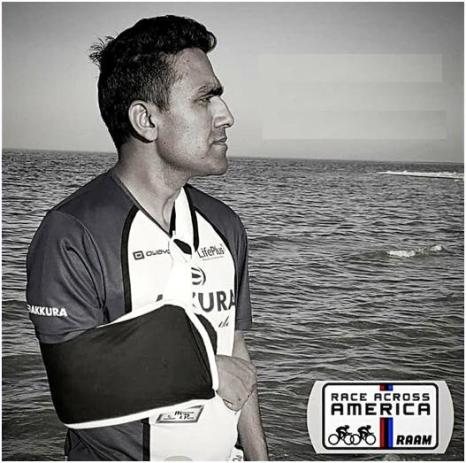
I have not finished every race I started. I broke my collarbone before one RAAM and had to abandon another after 4,200 kilometres when my health gave way. For a long time I treated those as failures. I don't any more. Knowing when to stop — when the line has crossed from discomfort into real harm — is not weakness; it is the judgement that lets you come back. And I did come back, and finished RAAM in 2024. The rider who stops wisely lives to start again. The one who can't tell the difference often doesn't.
The mental tools I actually use
- Break the impossible distance into small, winnable pieces.
- Ration sleep deliberately; master the timed micro-nap.
- Expect the hallucinations of the long dark, and trust your crew's clear head over your tired one.
- Separate discomfort from damage — argue with one, respect the other.
- Carry a reason bigger than yourself onto the road.
- Treat a wise stop as strength, not surrender.
The legs get you to the start of the hard part. After that, it's all in your head — and the good news is that the head, like the legs, can be trained.