

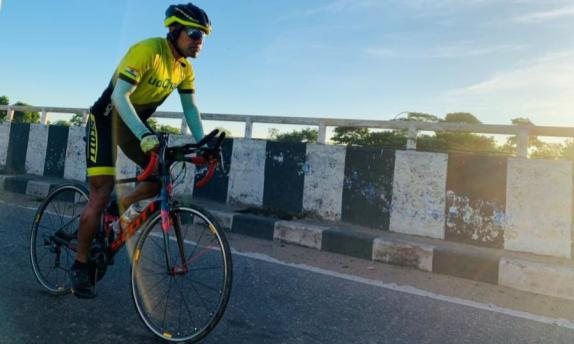
People assume ultra-races are won on the climbs or lost in the heat. In my experience they are won and lost at the stomach. You can be the fittest rider on the start line and still finish in an ambulance if you get your fuelling wrong. The engine is only as good as what you put in it, and over thousands of kilometres there is no hiding from arithmetic.
Here is the uncomfortable truth at the centre of long-distance cycling: you cannot out-train under-eating. On a multi-day ride the body burns through enormous amounts of energy, and if you fall into a deficit early, you don't notice it for hours — and then it arrives all at once, as a bonk you cannot climb out of. So my first rule is simple. Eat before you are hungry. Drink before you are thirsty. Once you are chasing the deficit, you have already lost time.
Carbohydrate is the currency
For the hours I am racing hard, I aim for roughly 60 to 90 grams of carbohydrate every hour. That is more than most riders think they can stomach, which is exactly why it has to be trained. I rely on a mix of carbohydrate types rather than one — the gut can absorb more when you give it variety — and I split intake between food I chew and calories I drink. Early in a race, when the stomach is still cooperative, I eat real food: rice, bananas, sandwiches, simple Indian meals the crew can prepare on the move. As the race wears on and the gut starts to rebel, I shift toward gels, drinks and anything that goes down without a fight.
Being a non-vegetarian gives me useful options for the longer, slower efforts — eggs and similar protein-rich foods sit well with me between the harder carbohydrate-heavy hours and help with the repair that never really stops over a multi-day ride. The principle is the same either way: keep the carbohydrate flowing, and use protein and fat to round out the longer, steadier stretches.
The stomach is the real limiter
Ask any ultra-cyclist what ended their race and a surprising number will say it wasn't the legs — it was the gut. Heat, fatigue and constant motion conspire to shut digestion down, and once you cannot keep food in, the countdown begins. So I treat the gut as a trainable organ. In the build-up I practise eating at race intensity, so that by race day my stomach is used to working while my heart rate is high. And I never, ever try a new food or product on race day. The road is no place for experiments.
Hydration sits alongside all of this. I drink to a schedule, not to thirst, and in our conditions I take in far more salt than a casual rider would imagine — the Indian heat strips sodium out of you, and cramping and confusion follow close behind. In the cold of high altitude the danger flips: you stop feeling thirsty, you drink too little, and you dehydrate without realising it. The thermometer changes the plan more than the distance does.
Different races, different plates
How I eat depends almost entirely on how long the race is.
On Manali to Leh — 472 kilometres done in just over 35 hours — there is barely time to sit down. The strategy is to push, sleep almost nothing, and keep the fuelling fast and simple, all the while fighting an appetite that the altitude and cold try to switch off.
On the Golden Quadrilateral, by contrast, I rode nearly 6,000 kilometres over almost fifteen days, around 400 a day, sleeping three or four hours a night. A race that long is not a sprint you tolerate; it is a life you have to sustain. The food has to be varied enough that I don't develop a revulsion to it, substantial enough to rebuild me each night, and gentle enough that my stomach is still willing on day twelve. Get bored of your own fuel and you will quietly stop eating it — which is just another road to the same deficit.
The crew makes it possible
None of this works without the people handing it up. On my record rides a dedicated nutrition crew plans the menus, preps the food, and times every handup so I almost never have to think about it. Their job is to do the worrying so that mine is only to ride. A rider who is also rationing his own food is a rider doing two jobs badly. Hand that second job to someone you trust.
What I'd tell a rider stepping up in distance
- Fuel from the first hour. The deficit you ignore early is the one that ends your race.
- Train your gut like a muscle — eat at intensity in your long sessions.
- Mix your carbohydrate sources and split intake between food and drink.
- Front-load real food while the stomach is fresh; lean on gels and liquids late.
- Drink and salt to a plan, and adjust hard for heat and altitude.
- Never debut a new food on race day.
- And if you can, give the fuelling to a crew — so all you have to carry is the effort.