

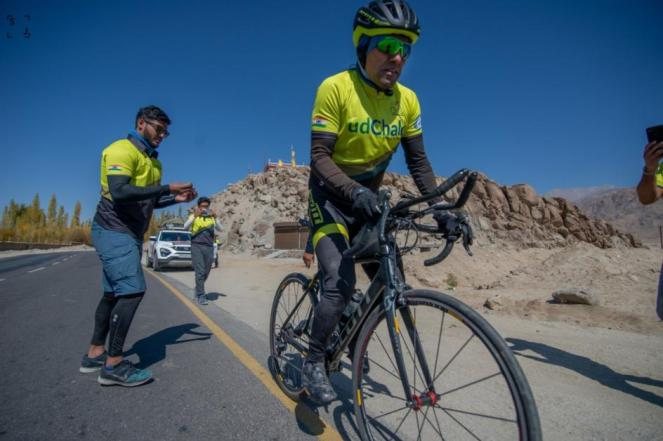
To race long distances in India is to race in several countries at once. You can leave a freezing high-altitude pass in the morning and be fighting a wet, suffocating heat by nightfall. The distance is only ever half the challenge. The other half is the weather and the terrain, and they are the opponents that don't tire.
I have learned this the hard way, in the cold of the Himalaya, the heat of the plains, and the storms of the Alps. Here is some of what those conditions taught me.
The cold and the thin air
Manali to Leh is, for my money, one of the most beautiful and most punishing rides anywhere. It climbs over four high passes — Tanglang La, Nakee La, Lachulung La and Baralacha La — and the air thins until every pedal stroke costs more than it should. At Sarchu, in the dark, I rode through temperatures around minus twelve. The Atal Tunnel, which would have spared me forty kilometres, wasn't open to me, so the route forced a detour over Rohtang on top of everything else.
You don't bluff your way through that. I spent around twenty days acclimatising before the record attempt, letting my body adapt to the altitude, because no amount of fitness substitutes for time spent high. At those heights two quiet dangers stalk you: the cold convinces you that you aren't thirsty, so you stop drinking and dehydrate without knowing it; and the thin air dulls your judgement just when you need it most. The cold isn't only uncomfortable — it makes you slower to think.
The heat and the long plains
The opposite extreme nearly broke me on the big mainland rides. Crossing the country edge to edge, and looping the Golden Quadrilateral, meant days in the kind of heat that empties you out — and, on the way, the rains of central India and the heavy, draining warmth of the south. In heat like that, the body spends so much of itself just trying to stay cool that there is less left for the pedals.
The plan in the heat is the mirror image of the plan in the cold. You drink far more than feels necessary and take in much more salt than you would imagine, because the heat strips it out of you and cramping follows fast. You pace with discipline, knowing the hottest hours are not the ones to be a hero in. And you protect against the sun like it's a competitor, because over many days it certainly behaves like one.
The mountains abroad
It isn't only India that does this. On the Race Around Austria, the Grossglockner rose to around 2,500 metres, and we hit it on the third day in near-freezing rain after the opening days had been hot — then the storms came in. Within a single race I got the full menu: heat, altitude, cold and weather, each demanding a different response. If there is a lesson in that, it is that adaptability, not just endurance, is what gets a rider to the finish.
Riding the extremes — what works
Whatever the conditions, a few principles have held up for me:
- Respect altitude with time. Acclimatise properly; fitness cannot shortcut it.
- Reverse your hydration logic for cold — you won't feel thirsty, so drink to a schedule anyway.
- In heat, over-drink, over-salt, and save your efforts for the cooler hours.
- Layer for the mountains and plan your descents — long, cold descents are where control and good braking matter most.
- Treat the sun and the weather as rivals, not background.
- Above all, stay humble. The mountain and the heat will always be bigger than you. The rider who races with the conditions, instead of against them, is the one who reaches the end.
India will give you every kind of weather a cyclist can face, sometimes in the space of a single day. Learn to ride all of it, and there are very few roads left that can stop you.